How to Prevent Awkward During Wedding Photography (And When to Lean Into it)
You don’t need to know how to pose before your photos.
A lot of people tell me they’re awkward in photos before we even start.
Sometimes they say it during the inquiry process, or they say it five minutes into the session. Sometimes it comes out as a warning, like they are trying to prepare me for the “impossible” task ahead.
I get it. Most people have had at least one photo experience where they were told to stand somewhere, smile, and somehow look natural with absolutely no useful direction. That makes anyone feel weird.
But being photographed isn’t supposed to be your job.
You don’t need to show up already knowing your best angles, where to put your hands, how to stand, when to smile, or how to make a pose look effortless. That is what you are hiring me for! My job is to guide you in a way that still feels like you, while paying attention to the things you should not have to think about, like light, movement, body language, angles, background, pacing, and how the photo feels after its been edited.
For my work, especially with Colorado weddings, elopements, and couples sessions, I love photos that feel grounded, outdoorsy, movement heavy, and a little bit editorial. I want the photos to feel natural, but I don’t believe “natural” means leaving you alone and hoping you suddenly know what to do.
Looking natural does not mean standing there without guidance.
There’s this idea that candid or documentary style photography means the photographer never steps in. Sometimes that is true. During a wedding ceremony, reception, getting ready moments, private vows, or emotional in between moments, I am watching what’s already happening and documenting it as honestly as I can, but portraits are different.
For couples portraits, wedding party photos, engagement sessions, elopements, and any moment where we’re intentionally creating space for photos, you shouldn’t be left wondering what to do next. That’s where direction really matters.
There’s a difference between photos that feel natural, and photos where the couple was just left alone.
Natural looking photos come from a mix of observation and direction. I’m watching how you interact with your surroundings, noticing the emotion in the room (even if your bff tries to hide her tears), and then shaping the scene enough so that the image works. Sometimes that means giving you a movement prompt, or sometimes that means adjusting your hands. Sometimes it means changing the angle, moving you into better light, or telling you to stop trying so hard for a minute. The goal is never to turn you into a different couple for the camera.
I start with movement because it gets you out of your head.
I usually start with movement because it gives you something to do.
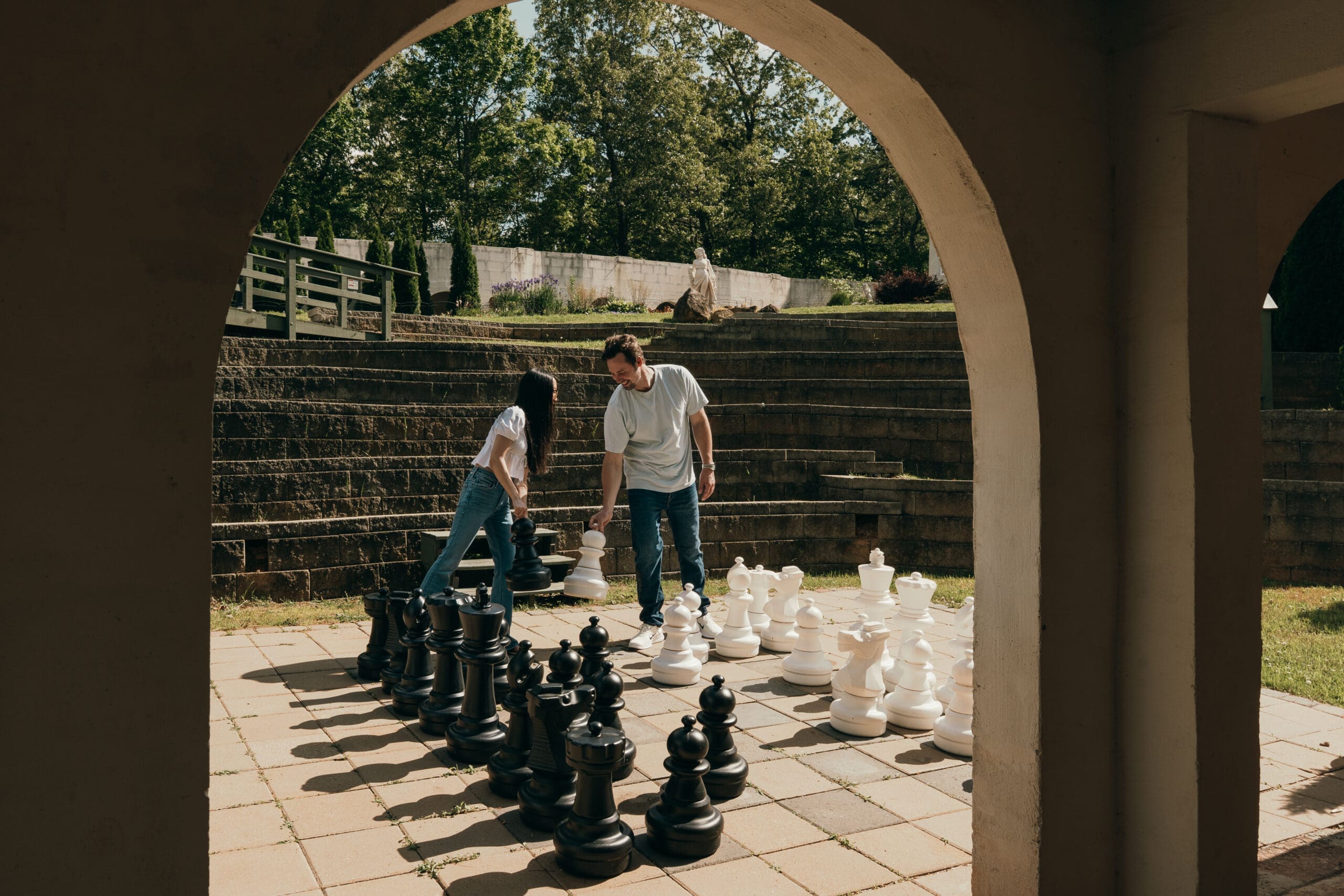
Instead of putting you in a still and serious pose right away, I will usually have you walk, hold hands, lean into each other, adjust a jacket, fix hair, pull each other in, sway, run, bump shoulders, or move through the space together. It sounds super simple, but it works because it shifts your focus away from the camera.
When you’re moving, you’re not just standing there and being hyper aware of yourself. You have an action and something to respond to. Your body relaxes faster because you aren’t trying to manufacture a “natural” expression out of thin air.
Movement also tells me a lot about you as a couple! Some couples are immediately playful and some are quieter and need a slower start. Some are affectionate but not super performative about it. Some are bold and editorial once they realize I am not going to make them do anything cheesy. Some need more structure at first, then loosen up once they understand how the session works.
I’m paying attention to ALL of that.
The first few prompts aren’t just about getting photos. They help me read your body language, your comfort level, your dynamic, your style, and the kind of direction that actually works for you. From there, the session starts becoming more specific to you instead of a copied and pasted posing routine.
Prompts are not the same thing as cheesy poses.
When I say I use prompts, I don’t mean that I’m making you do random things for the sake of being cute.
A prompt is direction with a purpose. It gives you an action, a feeling, or a way to interact so that the photo has life in it instead of stiffness. A prompt might be as simple as walking together while staying close, pulling each other in, fixing a sleeve, leaning into someone’s shoulder, or moving your hands through someone’s hair.
The point isn’t for you to perform the prompt perfectly. The point is to create movement and connection that gives us something real to work with.
Then I adjust from there.
I might tell you to bring your hand higher, soften your shoulders, step closer, turn your face toward the light, walk slower, loosen your grip, tilt your chin, or shift your weight. I might move around you until the angle works better. I might tell you to do the same thing again, but smaller. I might switch completely if the prompt doesn’t match your energy.
That’s the main difference between being posed and being directed.
Being posed feels like someone placed you somewhere and expected you to hold a position, while being directed feels like someone is actively guiding you through the photo so that you are not stuck trying to figure it out by yourself.
The right direction depends on the couple.
Not every couple needs the same kind of posing.
That’s another one of the reasons I don’t love overly rigid posing formulas. They can be helpful as a starting point, but if every couple gets the exact same direction, the photos start to feel disconnected from who they actually are.
Some couples need movement heavy prompts because they loosen up when they can laugh and interact. Some couples need a calmer pace because they feel more comfortable when things are slower and more intentional. Some couples photograph beautifully with dramatic editorial posing. Some look more like themselves when the direction is simple and subtle.
A big part of my job is just reading the room.
If you’re naturally playful, I’m not going to force you into a session that feels serious the entire time. If you are more reserved, I won’t push you into loud, over the top prompts that make you feel exposed. If you have a more editorial style, I am going to lean into stronger angles, posture, styling, and composition. If the whole vibe is earthy and outdoorsy, I am going to use the landscape, the wind, the movement, and the texture around us.
That is why direction matters so much. It is not just about avoiding awkwardness. It is about making sure the photos actually fit your vibe.
I’m watching all the angles so that you don’t have to.
One of the biggest reasons people feel awkward in front of the camera is because they think they have to monitor themselves the whole time.
You don’t.
You don’t need to know whether your hand looks weird. You don’t need to know if the light is better on one side of your face. You don’t need to know if your shoulders are tense, if the background is too busy, if the pose needs more movement, or if the angle is working.
That is what I’m here for!
I’m looking at how the light hits you. I am watching how your bodies connect. I am checking whether the pose feels comfortable or stiff. I am looking for tension in your hands, shoulders, jaw, and posture. I am paying attention to the background, the framing, the movement, and the way the photo will feel when you look back at it later.
This is especially important for outdoor sessions in Colorado.
A mountain, field, trail, overlook, or red rock location gives us a lot to work with, but it also comes with real variables: wind, uneven ground, bright sun, sudden weather shifts, dirt, movement, layers, and changing light. The environment can make photos feel incredible, but it needs to be handled intentionally.
You should be able to enjoy the session without mentally managing every detail, so I direct you through it!
Some awkwardness is worth keeping.
I don’t believe that the goal is to erase every trace of awkwardness.
Some awkwardness is actually the good part.
The clumsy movement, the laugh after a prompt feels ridiculous, the moment where one of you fully commits to the bit and the other one immediately loses it, the slightly chaotic walk through tall grass, the “we have no idea what we’re doing” energy that turns into something genuinely sweet, that’s so worth keeping. To be cringe is to be free! I stand by that!
I would rather you let yourself be a little weird than spend the entire session trying to look perfectly composed. Perfectly composed can get boring fast. It can also make the photos feel like they belong to someone else. The best photos usually have some kind of real reaction in them. That’s the awkwardness I will lean into.
Not because I want you to feel uncomfortable, but because there is a difference between awkward in a stiff way and awkward in a human way.
But I will never leave you in uncomfortable body language.
There is a kind of awkwardness I like, and there is a kind I actively prevent.
I love clumsy movement, real laughter, and the moments that feel a little imperfect in the best way.
I do not love stiff posing, uncomfortable body language, forced smiles, locked knees, tense hands, disconnected posture, or anything that makes you look like you would rather be anywhere else.
If something feels off, I’ll always fix it.
That might mean giving you a new prompt. It might mean pulling you closer together. It might mean creating more space. It might mean adjusting your hands, changing the angle, turning you toward the light, softening your posture, or giving you something to do so the expression is real instead of forced.
You shouldn’t feel like you’re failing at being photographed.
If a pose isn’t working, it’s not a personal flaw. It just means the direction needs to change. My job is to notice that before you start spiraling about whether you look weird.
I am not going to let you sit in a pose that feels uncomfortable and hope it magically gets better.
Earthy does not mean boring.
When I say earthy photography, I do not mean plain, overly muted, or completely stripped of personality.
For me, earthy means grounded. Outdoorsy. Connected to the setting. Full of movement, texture, wind, light, and emotion. It can feel soft or bold depending on the couple, the location, and the way we style the session.
Earthy can still be editorial.
It can still have a stronger pose, a dramatic angle, a black dress, a leather jacket, red rock, direct sun, flash, motion blur, messy hair, a bouquet with texture, or a little edge. It does not have to feel like everyone quietly wandered into a field and became beige.
That balance is a big part of my style.
I like photos that feel real, but I also care about how they are composed. I want the images to feel effortless, but they are not random. I want the movement to feel natural, but I am still choosing the light, the angle, the framing, and the moment.
That’s where the editorial part comes in.
It is not about making the session feel stiff or overly styled. It is about giving the photos intention.
This matters for weddings, elopements, and couples sessions.
For couples sessions and engagement photos, direction is usually the whole foundation of the session. We have space to move around, try things, change the energy, and build into the kind of photos that fit you best.
For elopements, the direction is more woven into the day. There are real moments happening, like getting ready, vows, walking to the ceremony spot, signing paperwork, celebrating after! I’m documenting those as they unfold. But when it is time for portraits, I’ll still guide you so that the photos feel intentional instead of random.
For weddings, it’s a balance. I’m watching for the real moments all day, but also stepping in when direction is needed. Family photos need structure. Wedding party photos need efficiency. Couple portraits need a mix of movement, posing, and breathing room so you don’t feel like your whole wedding day turned into a photoshoot.
What this looks like during a session.
At the beginning, I usually keep things simple.
We might start with walking because it gives you an easy rhythm. I will tell you where to go, how close to stand, whether to look at each other or away, and what kind of pace works best. I might have you hold hands, pull each other in, or move through the space while I watch how you naturally interact.
Then we build from there.
If you’re warming up quickly, I might move into more playful prompts. If the setting is dramatic, I might slow things down and create something more editorial. If the light is doing something gorgeous, I might pause the movement and guide you into a more intentional frame. If a pose feels stiff, we will move again.
It is not about forcing a session to follow a strict order.
It’s about starting with what helps you relax, then moving toward the photos that fit the location, the light, your style, and your relationship.
By the end, most couples who said they were awkward at the beginning are completely fine. Not because they magically became different people, but because they were not left to figure it out alone.
You don’t have to perform confidence.
This part is SO important.
You don’t need to show up acting like you are super comfortable in front of the camera if you aren’t. You don’t need to pretend you love being photographed. You don’t need to practice poses in the mirror, memorize inspo photos, or become a completely new version of yourself for the session.
The goal isn’t to make you fake confidence. The goal is to create enough structure and movement that you can settle in naturally. Confidence usually comes from feeling supported, not from being told to “just relax” while someone points a camera at you.
So I’ll give you direction. I will fix the weird hand thing. I will tell you when something looks good. I will move you if the light is better somewhere else. I will keep the session moving so you are not stuck overthinking one pose for too long.
Colorado is perfect for this kind of photography.
Colorado gives earthy, editorial photography so much room to breathe.
The mountains, open fields, red rock, pine trees, foothills, downtown Denver streets, and changing weather all add texture to the photos. It is not a blank backdrop. It has movement built in.
That is why Colorado works so well for couples who want photos that feel natural but still elevated. The location gives us atmosphere, and the direction gives the photos shape.
Whether we are photographing a Denver engagement session, a Colorado mountain elopement, a Boulder couples session, or a wedding with a view that already feels unreal, I am still thinking about the same things: movement, body language, light, connection, composition, and whether the photos feel like you.
I still photograph in Georgia too, and the same approach applies there in a different way. Georgia has its own texture, mossy trees, warm light, open fields, historic streets, gardens, lake days, and soft Southern landscapes. The setting changes, but the goal stays the same.
You can be awkward. I can work with that.
I don’t need you to be naturally good at being photographed. That’s not even a thing.
I need you to show up willing to move, trust the process a little, and let the session become what it needs to be. You don’t have to be perfectly polished or know your angles. You don’t even have to be serious the whole time just because the photos are editorial.
That is the whole point of hiring someone who knows how to direct without making the photos feel overly posed. You get to be yourselves, and I’ll handle the part where it turns into something beautiful, intentional, and actually worth keeping.
Final thoughts.
You don’t need to know how to pose before your wedding, elopement, engagement session, or couples photos.. You just need a photographer who knows how to guide you.
Someone who can tell when to step in and fix the stiff posing, when to let the movement keep going, when to lean into the laughter, when to slow everything down, and when to let the awkwardness become part of the story.
That is what I care about.
Photos that feel grounded, outdoorsy, movement heavy, and a little editorial shouldn’t feel stiff. They should feel directed, but not forced. Natural, but not random. Beautiful, but still honest.
So no, you do not need to know what to do with your hands.
I’ve got you.
Planning a Colorado wedding, elopement, or couples session? You don’t need to practice posing before your photos. Show up as you are, and I’ll handle the direction, movement, angles, and all the little details that make your photos feel natural.
FAQ
What if we are awkward in front of the camera?
This is completely normal. Most couples feel awkward at first, especially if they have never had professional photos taken together. You don’t need to know how to pose before your session. I use movement, prompts, and clear direction to help you relax and give your body something to do.
What are photography prompts?
Photography prompts are directions that create movement or interaction instead of asking you to hold a stiff pose. A prompt might involve walking, leaning into each other, adjusting clothing, holding hands, laughing through something, or slowing down for a more intentional frame.
What is earthy wedding photography?
Earthy wedding photography is grounded, outdoorsy, and connected to the setting. In my work, that usually means movement, texture, natural light, editorial composition, and photos that feel intentional without looking stiff or overly posed.
Do natural photos still need posing?
Yes. Natural photos usually still need direction. The difference is that the posing should feel guided instead of forced. I will help with angles, body language, movement, hands, and light so the photos look natural without leaving you to figure everything out alone.
Do you photograph weddings and couples in Colorado?
Yes. I photograph Colorado weddings, elopements, engagements, and couples sessions with a focus on earthy, editorial, documentary inspired photos that feel natural but still intentional.
Do you still photograph in Georgia?
Yes. Colorado is the main focus for this blog, but I still photograph select weddings, elopements, and couples sessions in Georgia and travel for the right stories.